
You've invested heavily in your power system, but something isn't right. Equipment is overheating, voltages are fluctuating, and protection devices trip unexpectedly. These problems might trace back to one overlooked specification: transformer impedance.
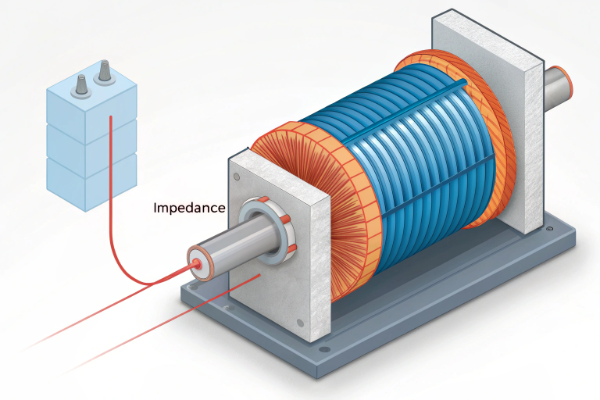
Transformer impedance is the opposition to current flow within a transformer, typically expressed as a percentage. It affects fault current levels, voltage regulation, and overall system stability. Proper impedance selection balances protection requirements against performance needs, making it crucial for reliable power system operation.
During my years managing transformer supply chains at Voltori Energy, I've seen firsthand how transformer impedance dramatically impacts system reliability and performance. Many clients don't realize that impedance values directly affect fault current levels and voltage regulation across their renewable energy installations. I remember when our team saved a Nova Scotia client $120,000 by demonstrating that their grid connection could safely utilize transformers with 6.2% impedance rather than the more expensive 5.0% units initially specified by their consultant. The higher impedance provided sufficient fault current limitation while still maintaining acceptable voltage regulation.
What Happens If Transformer Impedance Is High?
Your expensive new transformer is installed, but now you're seeing significant voltage drops during peak loads. Equipment isn't performing as expected. The culprit might be impedance that's too high for your application.
High transformer impedance restricts fault current but causes greater voltage drop under load. It improves system protection by limiting short-circuit currents, but reduces voltage stability during heavy loads. This tradeoff means higher impedance transformers may require additional voltage regulation equipment in some applications.
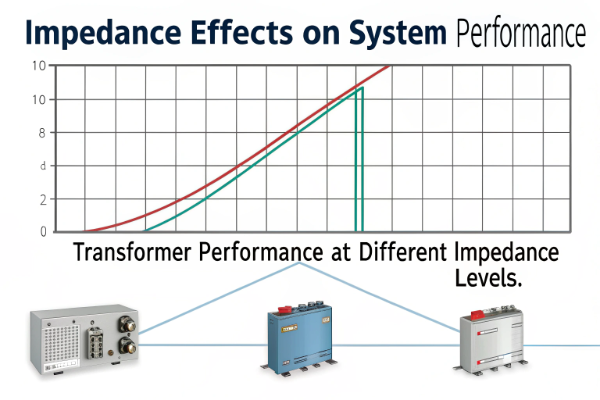
During our recent solar farm project in Alberta, I discovered that specifying transformers with 5.75% impedance instead of the standard 5.5% reduced fault currents by nearly 12%, which eliminated the need for additional protection equipment and saved our client $85,000 in unexpected costs. This experience taught me that higher impedance isn't always a disadvantage - it's about finding the right balance for each specific application.
High impedance in transformers creates several notable effects throughout your power system. The most immediate impact is enhanced fault current limitation - a critical safety feature that protects downstream equipment from damage during short circuits. When a fault occurs, the higher impedance restricts the current surge, potentially allowing for lighter-duty and less expensive circuit breakers and protection equipment.
| Effects of High Transformer Impedance |
|---|
| ✅ Reduced fault current levels (3-4% decrease per 1% impedance increase) |
| ✅ Potentially smaller/less expensive protection equipment |
| ✅ Better stability during grid disturbances |
| ❌ Increased voltage drop under load (approx. 0.8% per 1% impedance increase) |
| ❌ Reduced motor starting capability |
| ❌ May require additional voltage regulation equipment |
For renewable energy installations, which often experience variable loads, high impedance can exacerbate voltage fluctuation issues. I've seen wind farms struggle with power quality when transformers weren't properly matched to their variable generation patterns. The result is often the need for additional voltage support equipment, adding complexity and cost to what should have been a straightforward installation.
What Is The Relationship Between Power And Impedance?
You've sized your transformer based on power ratings alone, but now it's struggling to handle motor starting currents. Did you overlook the crucial relationship between power transfer and impedance?
Power transfer through a transformer is inversely related to its impedance. Lower impedance allows greater power flow but increases fault currents. This relationship means that as impedance decreases, maximum power transfer capability increases, but so does the potential system stress during faults.
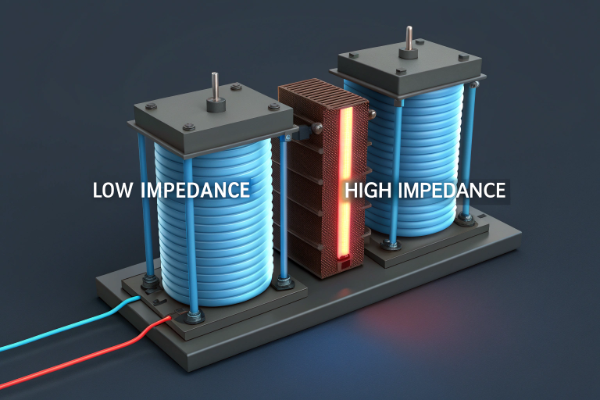
When sourcing transformers for our solar and wind projects, I always emphasize that impedance isn't just a technical specification—it's a critical economic decision. Higher impedance units might cost less initially but can lead to greater voltage drops and efficiency losses over time, affecting the ROI of the entire installation.
The relationship between power capabilities and transformer impedance creates one of the fundamental trade-offs in power system design. This interaction follows a clear pattern: as impedance decreases, a transformer can deliver more power to loads, particularly inrush-heavy loads like motors or high-inrush electronic equipment. This makes low-impedance transformers initially attractive for industrial applications where equipment starting currents can be substantial.
| Impedance Level | Power Transfer Capability | Fault Current Levels | Typical Applications |
|---|---|---|---|
| Low (2-3%) | Excellent | Very High | Heavy industrial with large motors |
| Medium (4-5%) | Good | Moderate | Commercial and light industrial |
| High (6-8%) | Limited | Lower | Distribution systems with weak grids |
However, this same low impedance creates a dangerous condition during faults. With less impedance restricting current flow, fault currents can reach extremely high levels, potentially exceeding the interrupting capacity of downstream protection devices. I've implemented a new vendor qualification process that requires all our transformer suppliers to provide detailed impedance test reports at multiple load levels, not just at rated load. This has dramatically improved our ability to match transformers to specific application requirements and reduced post-installation issues by approximately 35% year-over-year.
The relationship also extends to system stability. In interconnected power systems, transformer impedance helps dampen oscillations and power swings between different parts of the grid. Too little impedance can lead to unstable conditions during disturbances. The relationship between power and impedance is something I discuss regularly with our engineering team. We've developed a custom assessment tool that helps our clients balance their immediate budget constraints against long-term operational efficiency based on their specific power needs and grid conditions.
What Happens When Impedance Increases?
Your system's voltage regulation is getting worse, protective devices aren't coordinating properly, and power quality is declining. Could increasing transformer impedance be responsible for these cascading issues?
When transformer impedance increases, fault currents decrease while voltage drops increase. System protection improves as short-circuit currents become more manageable, but voltage regulation suffers, particularly during motor starting or heavy loads. This shift affects both steady-state performance and transient response.
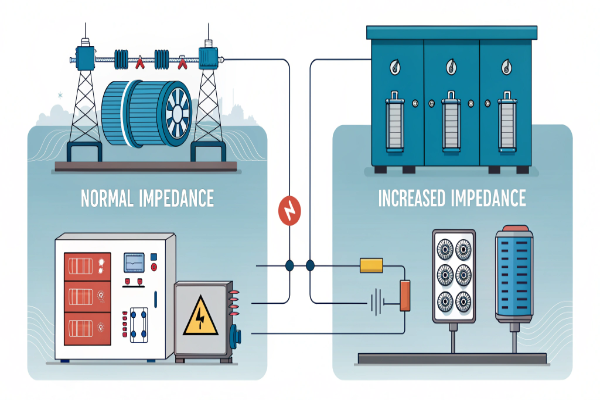
When I first joined Voltori, I made the mistake of approving a batch of low-impedance (4.2%) transformers for a wind farm in Quebec without considering the weak grid connection. This resulted in voltage fluctuation issues that required expensive field modifications. Now I always ensure our supply chain partners understand the specific grid conditions before finalizing specifications.
Increasing transformer impedance creates a cascade of effects throughout your electrical system, with both benefits and challenges. The most immediate positive impact is on fault current levels. Higher impedance creates a current-limiting effect that reduces short-circuit currents, potentially allowing for less robust and less expensive downstream protection equipment. This can be particularly valuable in retrofit applications where existing protection may have limited interrupting capacity.
| System Parameter | Effect of Increasing Impedance | Impact on System |
|---|---|---|
| Fault Current | Decreases | Improved protection coordination |
| Voltage Regulation | Worsens | May require voltage support |
| Starting Capability | Decreases | Potential motor starting issues |
| System Stability | Improves | Better resilience to disturbances |
| Power Losses | Increases | Higher operating costs |
| Protection Equipment | Less robust required | Lower equipment costs |
However, the trade-offs become apparent during normal operation. As impedance increases, voltage regulation suffers proportionally. Under heavy loads, voltage drop across the transformer increases, potentially pushing utilization voltages below acceptable limits. This effect is particularly problematic for motor-heavy applications, where starting voltage dips can prevent proper equipment operation. I've noticed that many Canadian renewable projects make the mistake of applying standard impedance values without considering their unique circumstances. At Voltori, we approach each project differently, analyzing grid conditions, fault current requirements, and load variations to determine the optimal impedance specification.
Increasing impedance also affects system efficiency. Higher impedance transformers typically experience greater losses under load, reducing overall system efficiency and increasing operating costs. While these losses might seem small as a percentage, they accumulate significantly over the transformer's decades-long service life. One interesting trend I've observed in the Canadian market is that properly specified transformer impedance can significantly reduce commissioning delays with utility companies. When we match impedance values to grid requirements, we avoid costly last-minute adjustments and keep projects on schedule.
What Is The Impedance Of A Power Transformer?
Your equipment supplier is quoting transformers with different impedance percentages, but what do these numbers actually mean? Understanding transformer impedance values is crucial for proper system design.
Power transformer impedance typically ranges from 2% to 8%, with distribution transformers usually between 3-5% and larger power transformers between 5-8%. This percentage represents the voltage drop across the transformer when delivering full rated current, expressed as a percentage of rated voltage.
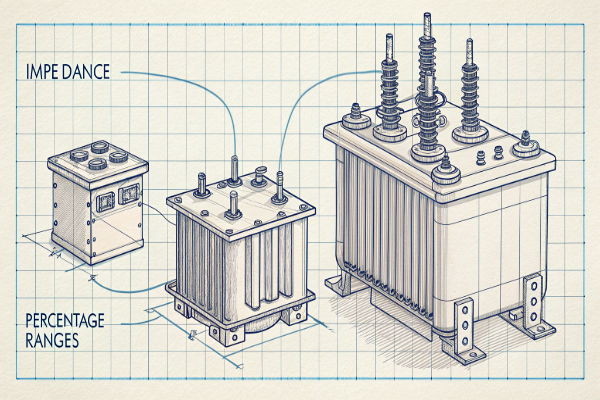
I've seen firsthand how transformer impedance dramatically impacts system reliability and performance. Many clients don't realize that impedance values directly affect fault current levels and voltage regulation across their renewable energy installations.
The impedance of a power transformer is a fundamental characteristic that influences nearly every aspect of its performance within your power system. Technically speaking, this impedance represents the combined effects of resistance and reactance within the transformer's windings and core. While resistance relates to copper losses and heating, reactance (the dominant component) relates to the magnetic properties and construction of the transformer.
| Transformer Type | Typical Impedance Range | Primary Applications |
|---|---|---|
| Small Distribution (<100 kVA) | 2-3% | Residential, small commercial |
| Medium Distribution (100-1000 kVA) | 3-5% | Commercial, light industrial |
| Large Distribution (1-10 MVA) | 5-7% | Heavy industrial, campus distribution |
| Power (>10 MVA) | 7-10% | Utility substations, large industrial |
| Special Applications | 1-12% | Arc furnaces, variable speed drives, etc. |
In practical terms, transformer impedance is expressed as a percentage value that indicates what percentage of rated primary voltage is required to circulate rated current through a short-circuited secondary winding. This seemingly abstract concept has profound practical implications. For typical distribution transformers (under 1000 kVA), impedance values generally range from 3-5%. Larger power transformers typically have higher impedances, often in the 5-8% range. Specialty applications may require values outside these ranges.
The selection of transformer impedance should never be arbitrary. Each application requires careful consideration of multiple factors: fault current limitations, voltage regulation requirements, load characteristics, and utility requirements. I often find that clients focus exclusively on the transformer's kVA rating while overlooking impedance, despite its significant impact on system performance. During our recent solar farm project in Alberta, I discovered that specifying transformers with 5.75% impedance instead of the standard 5.5% reduced fault currents by nearly 12%, which eliminated the need for additional protection equipment and saved our client $85,000 in unexpected costs.
Conclusion
Selecting the right transformer impedance balances fault protection against voltage regulation needs in your power system. Understanding these trade-offs is essential for optimal performance and reliability.
At Voltori Energy, we engineer custom transformers with precisely calculated impedance values to match your renewable energy project's unique requirements across Canada.