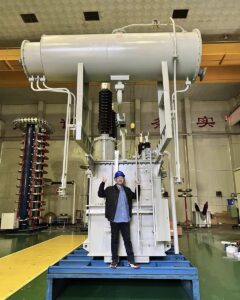

Power stations rely heavily on transformers, yet most engineers overlook critical specifications that impact performance and longevity. This oversight leads to premature failures and costly replacements, especially in harsh Canadian environments.
Power stations use several transformer types including generator step-up transformers (GSUs), power transformers, distribution transformers, and instrument transformers (CTs and VTs). Each serves specific functions within the power generation and transmission process, with specialized designs based on voltage requirements, cooling methods, and installation environment.

In my 15+ years managing transformer supply chains at Voltori Energy, I've witnessed countless procurement teams make costly specification mistakes. The wrong transformer choice doesn't just affect immediate performance—it can trigger cascading failures throughout your power infrastructure. Let me guide you through the essential transformer types and critical considerations that many specialists won't discuss.
Which Type of Transformer Is Used at a Power Station?
Power stations primarily rely on generator step-up transformers (GSUs), but many procurement teams underestimate their specialized requirements, leading to costly failures in Canadian conditions.
Generator step-up transformers (GSUs) are the primary transformer type used at power stations. They convert the relatively low voltage electricity produced by generators (typically 11-25kV) to high transmission voltages (110-765kV) for efficient long-distance transport through the grid.

When selecting GSUs for power stations, the oil formulation makes a tremendous difference in performance longevity. I've audited dozens of northern installations where standard mineral oil transformers failed prematurely. At Voltori, we specify specialized synthetic esters that maintain proper viscosity at -40°C for northern Canadian installations. This specialized oil costs about 22% more initially but extends transformer life by 7-9 years on average—a calculation many procurement teams miss when focusing solely on upfront pricing.
| Oil Type | Initial Cost | Performance in Cold Climate | Lifespan Extension |
|---|---|---|---|
| Standard Mineral Oil | Baseline | Poor below -25°C | Baseline |
| Synthetic Esters | +22% | Maintains viscosity to -40°C | +7-9 years |
| Silicone-Based | +35% | Excellent to -50°C | +10-12 years |
GSUs also require specialized protection schemes that differ from standard transformers. For renewable energy applications, particularly solar farms where generation can fluctuate rapidly, we implement adaptive protection parameters that adjust based on real-time generation levels, providing an extra layer of security against damaging fault conditions.
What Are the Four Types of Transformers?
Many engineers recognize the standard "four types" classification, but this oversimplification leads to improper specifications and unexpected performance issues in real-world applications.
The four main transformer types are: 1) Power transformers that handle high voltages in transmission networks, 2) Distribution transformers that reduce voltage for end-users, 3) Instrument transformers including CTs and VTs for measurement, and 4) Specialty transformers designed for specific applications like rectification or phase conversion.

The "four types" classification is actually an oversimplification. Beyond these basic categories, phase configuration dramatically impacts performance and reliability. Single-phase units offer redundancy advantages for critical infrastructure—when one unit fails, the others can continue operating at reduced capacity. Three-phase designs reduce installation footprint by approximately 40%, making them preferable for space-constrained substations.
| Transformer Type | Primary Function | Typical Voltage Range | Key Specification Consideration |
|---|---|---|---|
| Power Transformers | Transmission network voltage conversion | 115kV to 765kV | Cooling system design and short-circuit strength |
| Distribution Transformers | Voltage reduction for end-users | 4.16kV to 35kV | Environmental protection and overload capability |
| Instrument Transformers | Measurement and protection | Varies by system voltage | Accuracy class and burden rating |
| Specialty Transformers | Application-specific functions | Application dependent | Custom electrical characteristics |
The material composition of core steel significantly impacts both performance and lead times. I've guided many clients to specify silicon steel grade M4 rather than M6, resulting in 30% faster sourcing with negligible performance differences in most applications. This small specification change can reduce project timelines by 3-7 weeks—crucial knowledge when managing critical path components for renewable energy projects with tight commissioning deadlines.
What Are the Different Types of Substation Transformers?
Substation transformers come in numerous configurations, but cooling system design is the critical differentiator that many specification engineers overlook, especially for Canadian applications.
Substation transformers include transmission substation transformers (handling very high voltages), distribution substation transformers (reducing voltage for local distribution), collector substation transformers (common in renewable energy), mobile substation transformers (for temporary needs), and autotransformers (for connecting systems with different voltages).

For substation transformers, cooling system design is the real differentiator that impacts long-term performance. ONAN (Oil Natural Air Natural) cooling systems may appear cost-effective initially, but our operational data consistently shows ONAF (Oil Natural Air Forced) systems deliver 15-20% better performance during summer demand peaks in southern Canadian applications, despite the 8-12% higher upfront cost.
| Cooling System Type | Initial Cost | Performance During Peak Demand | Maintenance Requirements |
|---|---|---|---|
| ONAN (Oil Natural Air Natural) | Baseline | Standard | Minimal |
| ONAF (Oil Natural Air Forced) | +8-12% | +15-20% capacity | Periodic fan maintenance |
| OFAF (Oil Forced Air Forced) | +20-25% | +30-35% capacity | Regular pump and fan service |
Through my involvement in commissioning dozens of substation transformers, I've also observed that many specification teams overlook bushings—the critical connection points between transformers and transmission lines. Standard porcelain bushings perform adequately in moderate environments, but our northern installations require composite bushings with enhanced contamination performance. The extra $15,000-20,000 investment prevents flashovers during spring thaw periods when salt and industrial contamination accumulate on traditional bushings.
Monitoring requirements also vary substantially between substation types. At transmission substations, we recommend comprehensive dissolved gas analysis (DGA) systems with continuous monitoring, which adds roughly $35,000 to the initial cost but provides early detection of developing faults. For distribution substations, simpler monitoring focusing on oil temperature and pressure often suffices.
What Are CT and VT Transformers?
CT and VT instrument transformers may seem like minor components, but their accuracy directly impacts protection system performance and revenue metering—areas where even small errors have major financial implications.
Current transformers (CTs) convert high primary currents to standardized low secondary currents (typically 5A or 1A) for measurement instruments. Voltage transformers (VTs) or potential transformers (PTs) reduce high system voltages to standardized low voltages (typically 120V) for safe measurement, protection, and control applications.

With CT and VT instrument transformers, accuracy class is absolutely critical yet frequently misspecified. I've reviewed utility installations where 0.5 class devices were installed when protection schemes required 0.2S accuracy. This seemingly minor specification difference leads to ghost trips and unnecessary outages that can cost hundreds of thousands in lost generation revenue.
| Accuracy Class | Maximum Error | Suitable For | Cost Premium |
|---|---|---|---|
| 0.1 | ±0.1% | High-precision metering | +120% over standard |
| 0.2S | ±0.2% | Revenue metering | +70% over standard |
| 0.5 | ±0.5% | Regular metering | Standard pricing |
| 5P | ±1% (plus performance under fault) | Basic protection | Standard pricing |
The location of instrument transformers within the substation also matters significantly. During a recent optimization project for a wind farm collector substation, we discovered that relocating CTs from the low-voltage to the high-voltage side of the main transformer eliminated measurement distortion caused by capacitive coupling effects. This simple repositioning improved metering accuracy by approximately 0.3%, which translated to nearly $95,000 annually in properly accounted energy production.
Protection-class and metering-class instrument transformers have fundamentally different response characteristics. Protection-class devices maintain accuracy during fault conditions but sacrifice some precision during normal operation. Metering-class devices provide excellent accuracy under normal conditions but saturate during faults. I've guided many clients to install dual-core designs that satisfy both requirements without compromise, despite the higher initial investment.
Conclusion
Selecting the right transformer type for your power station requires understanding both technical specifications and real-world operating conditions. With properly specified transformers, you'll maximize efficiency and minimize costly failures.
At Voltori Energy, we engineer custom transformers specifically for Canadian renewable energy applications, ensuring your power infrastructure performs reliably in even the harshest conditions.